By Subhan Ullah – Digital PR at Pure Matrimony, a UK-based platform helping practicing Muslims find a spouse.
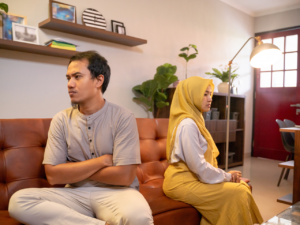
Most couples are surprised by their first real argument. It is rarely about anything big: a visit to the in-laws, an unexpected purchase, or a remark taken the wrong way. Yet it can leave both people wondering whether something has gone wrong.
It has not. Two people from different homes are learning to live as one household, and disagreement is part of that. What matters is how it is handled, and the home of the Prophet ﷺ offers a practical model.
Expect differences, and look for the good
Allah (swt) tells husbands to live with their wives in kindness, and adds: “For if you dislike them, perhaps you dislike a thing and Allah makes therein much good.” (An-Nisa 4:19)
The verse prepares the believer for moments of dislike rather than pretending they will never come.
In his Tafsir of this verse, Ibn Kathir describes how the Prophet ﷺ was cheerful and playful with his wives, compassionate towards them, spent on them and laughed with them.
Allah (swt) also describes marriage as a bond of “affection and mercy” (Ar-Rum 30:21). Ibn Kathir notes that a spouse may stay out of love, or out of compassion. On difficult days, mercy carries a marriage when affection feels thin.
Practical steps:
- Before reacting, recall three qualities you value in your spouse.
- Treat a disagreement as a shared problem, not a contest.
Learn to read your spouse
The Prophet ﷺ once said to Aishah (rta): ” ‘I know when you are pleased with me or angry with me.’ When she was pleased, he explained, she would say: ‘No, by the Lord of Muhammad’, and when she was upset, ‘No, by the Lord of Abraham’. She replied that, even then, she only left out his name.” (Bukhari)
He paid such close attention that he noticed a change in a single word, and he raised it gently rather than letting it pass unnoticed.
Practical steps:
- In the first months, learn the small signs when your spouse is tired, hurt or upset.
- Ask “Is something bothering you?” before a small hurt grows.
Cool down before you talk it through
One day the Prophet ﷺ came to the house of his daughter Fatimah (rta) and found that Ali (rta) was not there. She told him that there had been something between them, and Ali (rta) had gone out angry. The Prophet ﷺ found him asleep in the Masjid, covered in dust. He wiped the dust from him and said: “Get up, O Abu Turab (father of dust).” (Bukhari)
Ali (ra) did not stay and let the argument grow; he only took himself away from home, until his anger settled. The Prophet ﷺ did not take sides or lecture. He came with warmth, and Ali (rta) later said no name was dearer to him than Abu Turab.
The Prophet ﷺ repeatedly advised a man: “Do not become angry.” (Bukhari) He also taught that someone angry while standing should sit down, and if that does not help, lie down. (Abu Dawud)
Practical steps:
- Agree in advance that either of you can pause a heated discussion and return to it later the same day.
- Change your position, make Wudu or step out for a short walk, then return to talk calmly.
Value each other’s counsel
At Hudaybiyah, when the companions were slow to sacrifice their animals and shave their heads as instructed, the Prophet ﷺ told Umm Salamah (ra). She advised him to go out without speaking to anyone and sacrifice first. He did, and they followed at once. (Bukhari)
If the Messenger of Allah ﷺ acted on his wife’s advice at such a moment, newlyweds can certainly consult each other on decisions that affect them both.
Honour each other’s families
Years after Khadijah (rta) passed away, the Prophet ﷺ would still send portions of meat to her friends. (Bukhari) His kindness to his wife extended to the people she had loved.
Speak well of your spouse’s family, keep up the visits that matter to them, and keep your disagreements private. If a dispute becomes serious, the Quran describes sending one arbitrator from his family and one from hers: “If they both desire reconciliation, Allah will cause it between them” (An-Nisa 4:35). Ibn Kathir notes that Allah (swt) gives preference to the couple staying together. The aim is reconciliation, not a family battle.
Make money a shared conversation
Many early disagreements are about money. The Prophet ﷺ taught that of all the money a person spends, the Dinar spent on one’s family brings the greatest reward (Muslim), and that even a morsel a man places in his wife’s mouth is rewarded when done for Allah’s (swt) sake. (Bukhari) The Quran praises those who spend “not excessively or sparingly”, but justly in between. (Al-Furqan 25:67)
Practical steps:
- Sit down together in the first month and agree on household costs, savings and any support for parents.
- Decide on a sum each of you can spend without needing to consult the other.
Keep the lightness
The Prophet ﷺ raced Aishah (rta) on a journey. She won the first time. Later, he won and said: “This is for that.” (Abu Dawud) He also said: “The best of you is the best to his wives, and I am the best of you to my wives.” (Tirmidhi)
Couples who share laughter recover more easily from a hard conversation, so keep time for each other that has nothing to do with chores or bills.
A closing reminder
Allah (swt) praises those: “who restrain anger and who pardon the people” (Aal-Imran 3:134), and commands: “Repel [evil] by that [deed] which is better.” (Fussilat 41:34) Handled with patience and mercy, the tests of the first year can become the foundation of a marriage that brings both spouses closer to Allah (swt).
Views: 36